
Degreasing and Spot Priming
Oil-stained areas are cleaned and primed as their own step. It is the least visible part of the job and the one that most often decides whether a coating is still intact a year later.
Serving Los Angeles, California & surrounding areas
Mon–Fri 8am–6pm Sat 9am–2pm
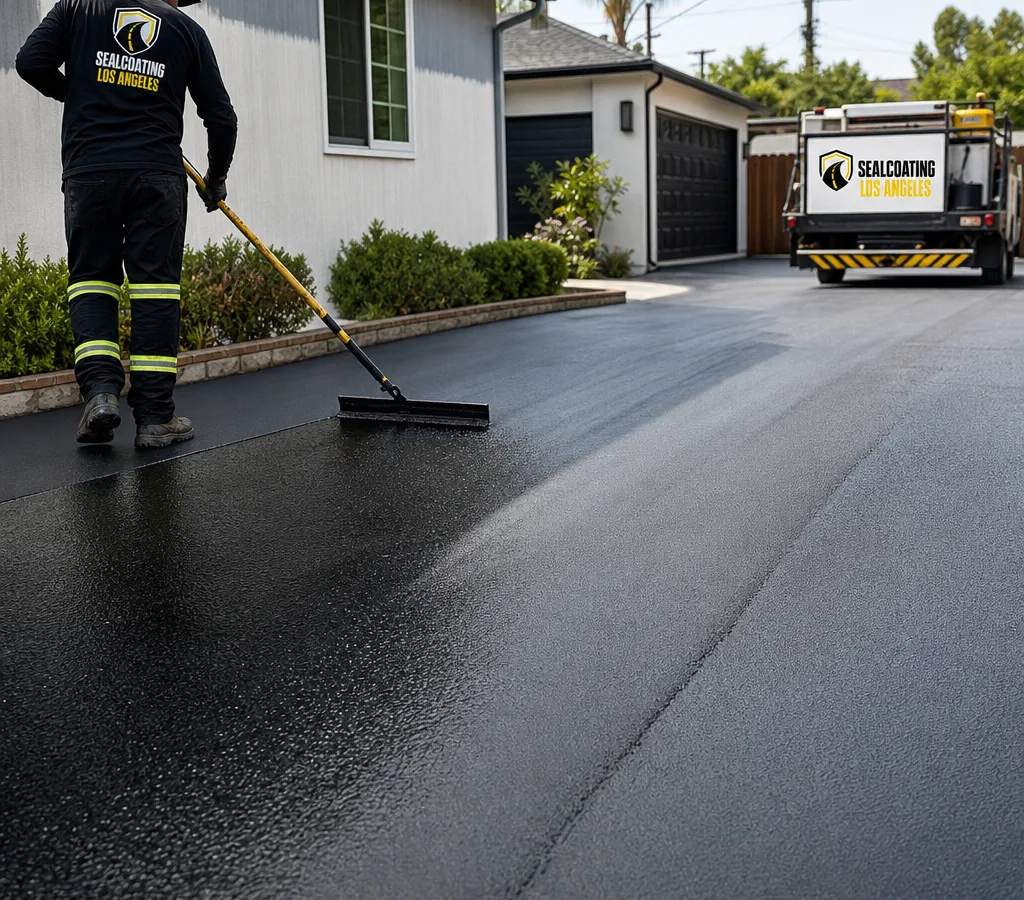
Marine air and loaded axles age asphalt faster than sun alone. We degrease fuel and oil spotting, treat the edges salt reaches first, and coat for surfaces that work hard.
Pavement near the water takes on a kind of wear that inland asphalt does not. Salt-laden air settles on the surface and keeps working at the binder, so the mat goes gray sooner and loses the flexibility that holds it together under load. Sealcoat is the layer that slows that exchange down.
Add commercial traffic to the same surface and the picture changes again. Loaded trucks put far more weight through a small contact patch than cars do, and they concentrate it where they turn, brake, and sit waiting. Those spots show wear long before the open middle of a lot does.
So a coating here is judged on two things: how well it bonds to a surface that has been collecting salt and residue, and whether the prep dealt with the places that carry real weight. We work on both before anything is applied.
Every surface gets walked before we quote it. On this side of the county we are reading for contamination and for load damage, because those two decide whether a sealcoat will hold or lift within a season.
Some of what we find is worth coating straight away. Some of it needs repair first, and we would rather say so at the walkthrough than coat over a problem that will come back through.
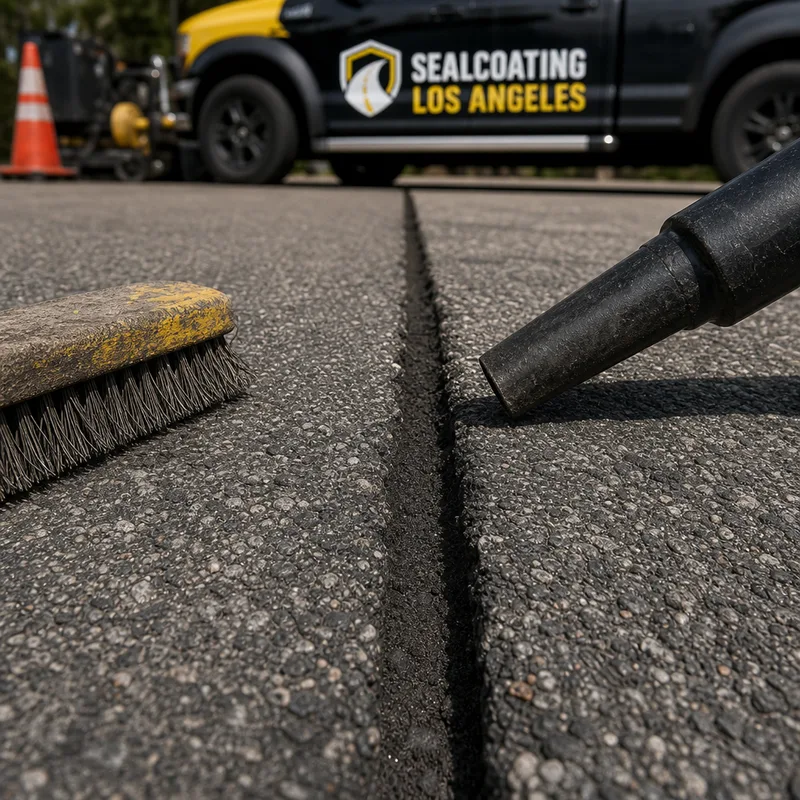
The work is organized around contamination, load, and water, because those three decide how long a finish lasts on pavement near the port.
Oil-stained areas are cleaned and primed as their own step. It is the least visible part of the job and the one that most often decides whether a coating is still intact a year later.
Blowing a lot clear is not cleaning it. We remove the built-up film that collects on coastal pavement so the sealer meets asphalt, which is the only surface it can actually bond to.
Drive lanes, approach aprons, and dock turns get read as their own areas. Treating them identically to a quiet parking row is how a lot ends up failing in patches.
Open cracks let salt water reach the base. They are filled and sealed ahead of the coat so moisture is not simply covered over and left to work underneath.
Curbs, gutters, and concrete joints are cut in by hand. A clean line there is what keeps water from tracking under the new surface at the one point it is most likely to.
We walk the whole area, mark the fuel and oil spots, and note where weight concentrates. That map determines the prep plan and the quote.
Salt film, grit, and traffic residue are taken off the surface. This is the step that decides adhesion, and it is where cutting corners shows up first.
Petroleum-contaminated areas get treated separately and primed once dry. Until that holds, the rest of the schedule stays flexible.
Open cracks are filled and failing edges addressed, so the coating goes over a surface that is sound rather than one that is simply covered.
We apply an even coat and set the cure window around your operation, reopening in stages where a lot cannot close all at once.
Commercial lots are measured by area. Sealcoating typically runs about $0.20 to $0.35 per square foot, and where prep is heavy, with widespread degreasing or repair, it moves toward $0.55 to $0.85 per square foot. Residential driveways usually land between $250 and $600, with larger multi-car driveways around $700 to $900.
Crack filling is quoted on linear footage and often falls between $350 and $1,500. Where the asphalt needs structural patching rather than protection, repair work starts near $2,500 and larger scopes run $3,000 to $6,000 or beyond. The figure that matters is the one written after we walk the surface.
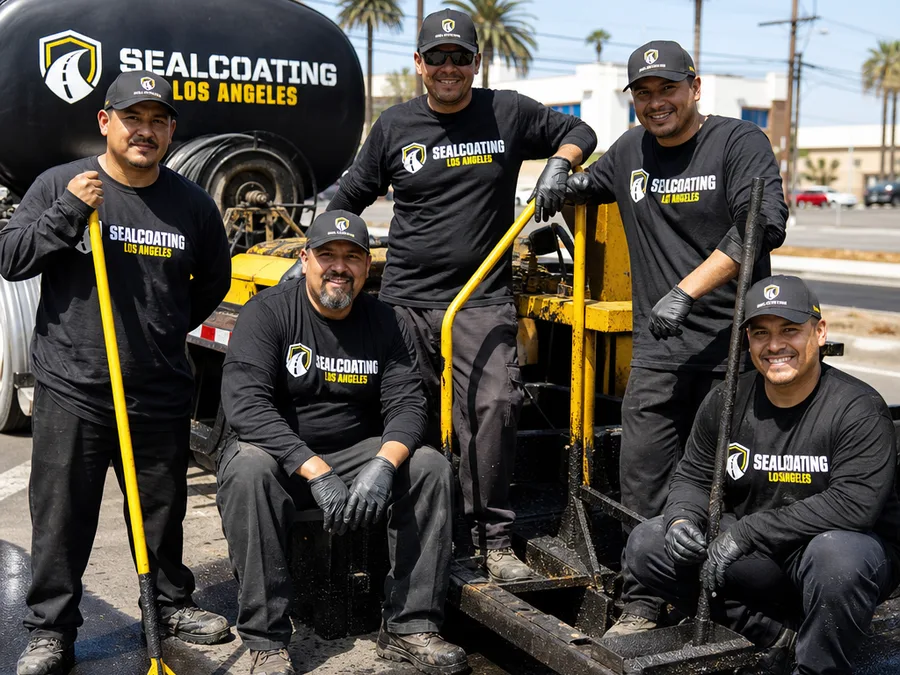
Book Your Free InspectionA look at prepared surfaces, finished coating, and the staging that keeps a working lot usable while the asphalt cures.
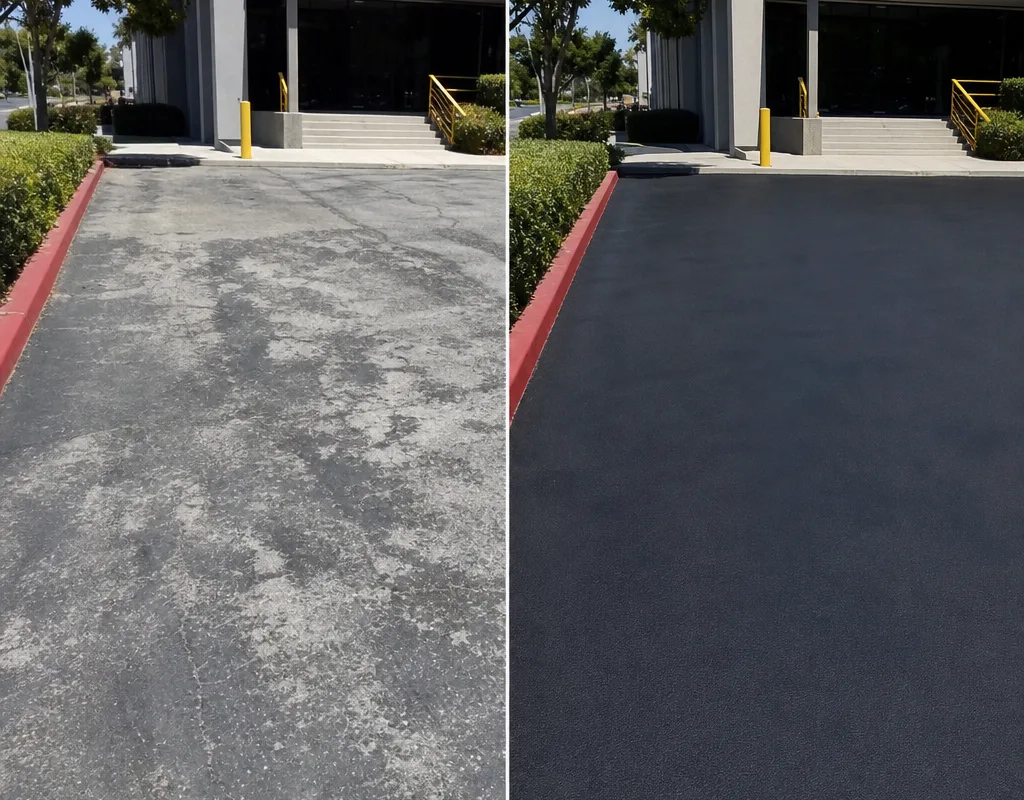
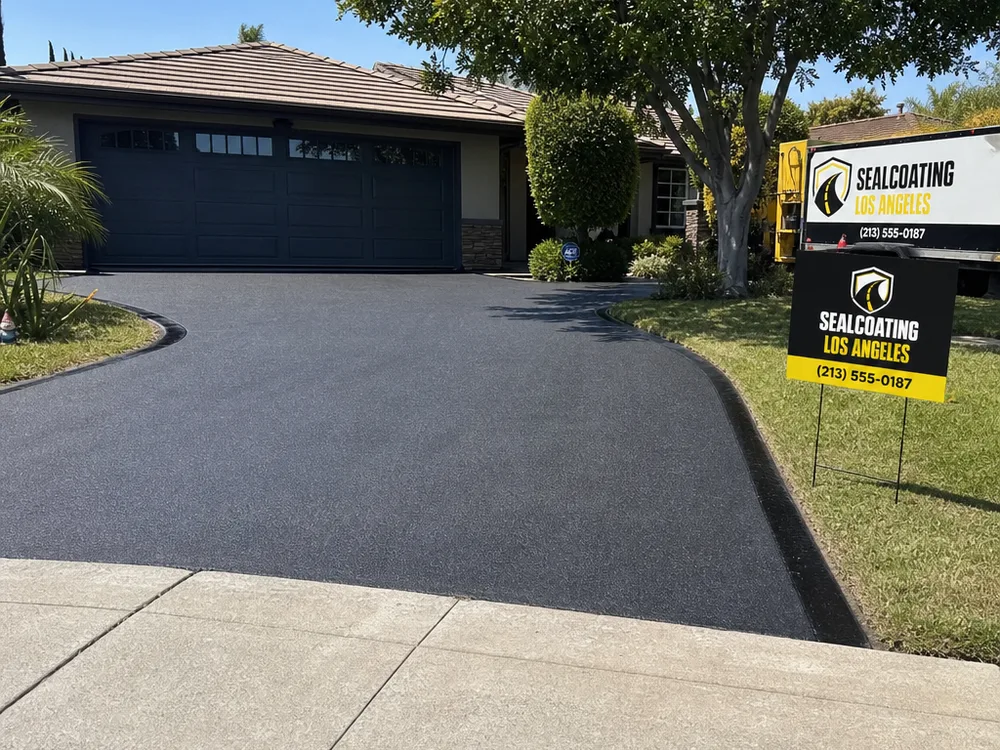
Questions we hear most from property managers running lots that stay busy and sit close to the water.
It contributes. Salt-laden air keeps moisture and chloride in contact with the surface, which accelerates the oxidation that turns asphalt gray and brittle. It is not the only factor, but on pavement near the water you generally see binder age faster than you would on an equivalent inland surface.
Sealcoat is a protective layer, not a structural one. It shields the binder from water, fuel, and UV, and it handles traffic well once cured. What it cannot do is carry weight the base underneath cannot. If a lot is failing under load, the repair has to come first or the coating simply follows the failure.
Petroleum breaks down asphalt binder and leaves a surface sealer will not stick to. If those areas are coated without degreasing and priming, the sealer lifts off them within months while the surrounding lot stays intact. Treating them as their own step is what prevents that patchy failure.
Usually, yes. Most commercial work here is phased so part of the lot stays open while another part cures. Tell us your delivery windows and busy periods at the walkthrough and we will build the sequence around them rather than asking you to close entirely.
Cure time depends on temperature, humidity, and how much air is moving across the surface. Passenger vehicles return sooner than heavy equipment. We give you a specific window at the walkthrough and mark the reopening order, since loaded axles on a surface that is not ready will mark it.
It depends on traffic volume and exposure rather than a fixed calendar. A lot carrying constant truck movement needs attention sooner than a quiet one. We would rather look at the surface and tell you it has another season in it than put everything on a schedule that ignores condition.
If your lot is collecting oil spotting and the surface has gone gray, start with a walkthrough so the prep is scoped properly.
Book Your Free InspectionTell us the surface size, the traffic it carries, and what you are seeing in the staining and edges. We will confirm what needs degreasing, what needs repair, and what sealcoat can protect, then put it in writing.
Request a quote
Send the surface, its size, and what you are seeing. We reply with next steps and a time for a walkthrough.